[ Success Story ]

Laurent Capron
International Technical and Sales Senior Consultant
International Technical and Sales Senior Consultant
4 Min
+ + + Located in a seismically active region at the junction of the Alps and Jura mountain ranges, CERN regularly experiences ground motion generated by natural seismic events as well as environmental and human-made sources. These disturbances are continuously monitored through dedicated measurement systems and provide valuable data for understanding the behavior of large-scale scientific infrastructures and validating digital models used for future accelerator studies. + + +
The Future Circular Collider (FCC), currently under study as a potential successor to the Large Hadron Collider (LHC), is envisioned as one of the largest and most precise scientific instruments ever built. With a circumference of approximately 91 km, its performance would depend on the precise alignment and stability of thousands of accelerator components.
Ground motion generated by natural seismic activity, environmental influences and human activities can induce small displacements of accelerator elements. Although often imperceptible, these movements can affect beam stability and machine performance. Understanding, monitoring and modelling such phenomena therefore represents an important aspect of the design and operation of current and future accelerator infrastructures.
Ground motion generated by natural seismic activity, environmental influences and human activities can induce small displacements of accelerator elements. Although often imperceptible, these movements can affect beam stability and machine performance. Understanding, monitoring and modelling such phenomena therefore represents an important aspect of the design and operation of current and future accelerator infrastructures.
Ground motion and environmental vibrations are continuously present in large-scale scientific infrastructures and can influence the alignment and stability of critical components. The challenge is to develop a system capable of continuously integrating measurement data with simulation models to assess, in real time, the impact of ground motion on accelerator infrastructures. By combining monitoring and predictive modelling, the objective is to identify critical vibration modes, improve the understanding of structural behavior and provide valuable information to support the design, operation and future development of facilities such as the FCC.
- To meet this challenge, a digital twin is being developed of a prototype of FCC’s mechanical structure. This digital twin represents a detailed representation of the physical structure in a cloud and makes it possible to simulate mechanical relationships through physical-mathematical modeling (finite element analysis, FEA).
- The approach goes far beyond classic simulations: Whereas in the past only components were simulated and then manufactured, today a digital twin exists over the entire service life of a complete structure. The special feature is the combination of simulated mechanics and real-time data from sensors, which continuously display and monitor the behavior of the structure in near real time.
- With the help of special seismic sensors, ground movements are measured in real time and compared with the simulation models. If a critical vibration is detected, the system can react within fractions of a second.
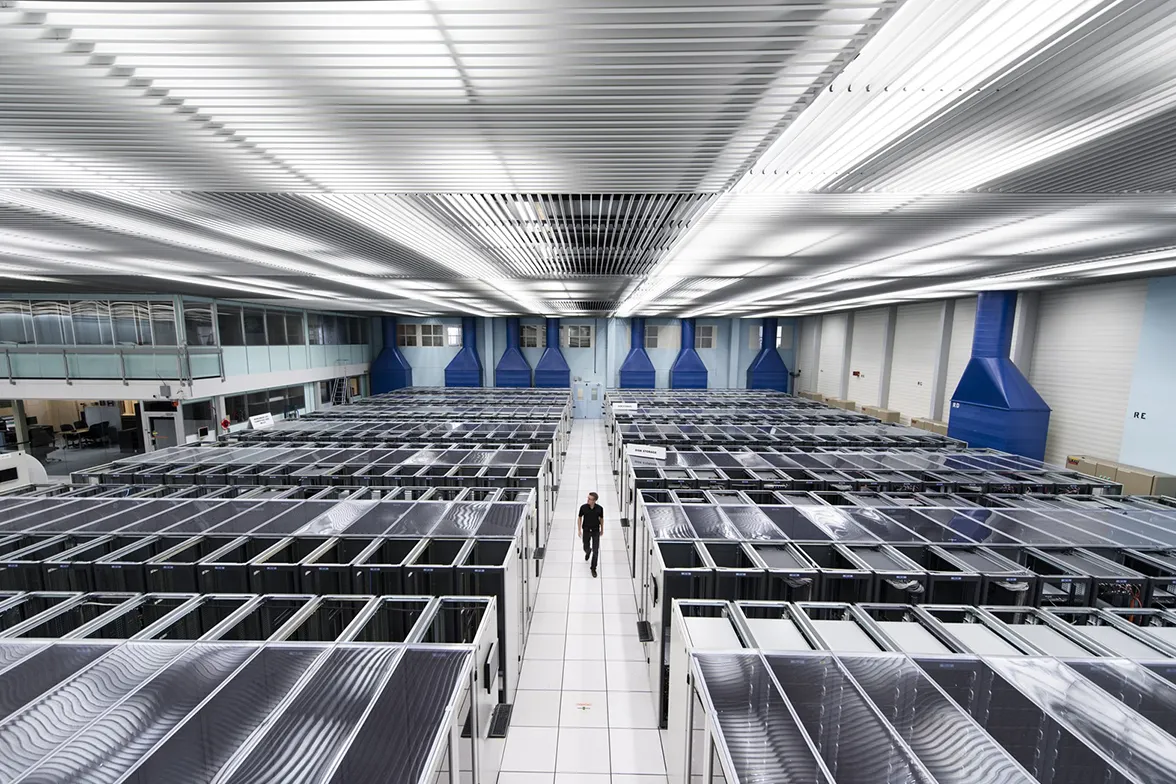
Server room at the data center.
CERN / Maximillien Brice / Anna Pantelia
CERN / Maximillien Brice / Anna Pantelia
- The hybrid structure of the Digital Twin – mechanical simulation and real-time data integration – allows the measurement of seismic waves and the feeding of the values into the model. Excited with defined boundary conditions, it is possible to calculate how the system will behave in view of the critical natural vibrations. This prevents deflection of the particles and possible damage.
- A decisive success factor is the implementation of a suitable middleware architecture that impresses with its extremely low latency. This precisely tuned approach not only enables outstanding performance values but also ensures a lightning-fast response to seismic events.
- The Edge IIoT framework ensures that different sensor models can be easily integrated – from individual seismometers to large-area sensor clusters. The Web Of Things technology ensures that the sensor data is connected generically.
- NVH-One as a central component, specialized in the processing of physical-dynamic data, provides the necessary analyses and evaluations.
NVH-One has made a decisive contribution to the development of this system with its unique approach. Its specific added value lies in the combination of an edge computing framework, high-performance message-oriented middleware, cloud-based data processing and a flexible digital twin architecture that can be adapted in a wide variety of industrial applications.
01
Edge IIoT Framework – Sensor Integration without Limits
A central element of the solution is the NVH-One Edge IIoT Framework. It enables a universal connection of sensors and data models, so that a wide variety of measurement systems can be integrated without time-consuming adjustments. This creates a scalable platform that can be used from small sensor units to large-scale networks.
02
Real-Time Data Processing with Minimal Latency
Thanks to the middleware architecture, NVH-One can ensure ultra-low latency and high data availability. This enables an almost instantaneous analysis and response to seismic events.
03
Web Of Things – Standardized and Machine-Readable Data
Another advantage is the Web Of Things technology, which NVH-One has adapted specifically for industrial IoT applications. This enables a structured and semantically interpretable data description that can be easily understood not only by machines but also by humans. This is supported by the dedicated W3C standard.
04
From Theory to Practice: PAK Live Edge Streaming Client
Via the PAK Live Edge Streaming Client, raw seismic data from any PAK live measurement system is translated directly into edge protocols and then integrated into the middleware. This ensures a direct link between measurement data and the Digital Twin architecture, enabling immediate interpretation and use of the data.
05
Automated Real-Time Evaluation
A special feature is the ability to evaluate seismic and other dynamic data such as vibrations or mechanical stress directly in the cloud – virtually in real-time. NVH-One combines configurable ETL processes, which users can define themselves via a graphical interface and output up to complete reports, with high-speed modules for analyzing raw data in fractions of a second.
The partnership with CERN impressively demonstrates how innovative mechanical simulation can be combined with modern real-time data integration. The success of this project lays the foundation for new standards in digital process monitoring and could find its way into many industrial applications in the long term.
Modern sensors allow us to detect and characterize ground motion with exceptional precision. By combining continuous streams of measurement data with real-time simulations and machine-learning algorithms, we are moving towards a new generation of digital twins capable of predicting the dynamic behavior of accelerator components in near real time. This opens exciting opportunities for improving our understanding of complex infrastructures and supporting future operational decisions.
Michael Guinchard
Resp. of the Mechanical Measurement Lab
In addition to the direct application of simulation-based monitoring at CERN, the digital twin approach opens new perspectives in many areas, such as in construction for building monitoring or in large-scale industrial turbine construction. With the goal of a standardized technology that automatically corrects both man-made and critical environmental influences, this would be a big step towards autonomous, self-regulating systems in high-precision research.
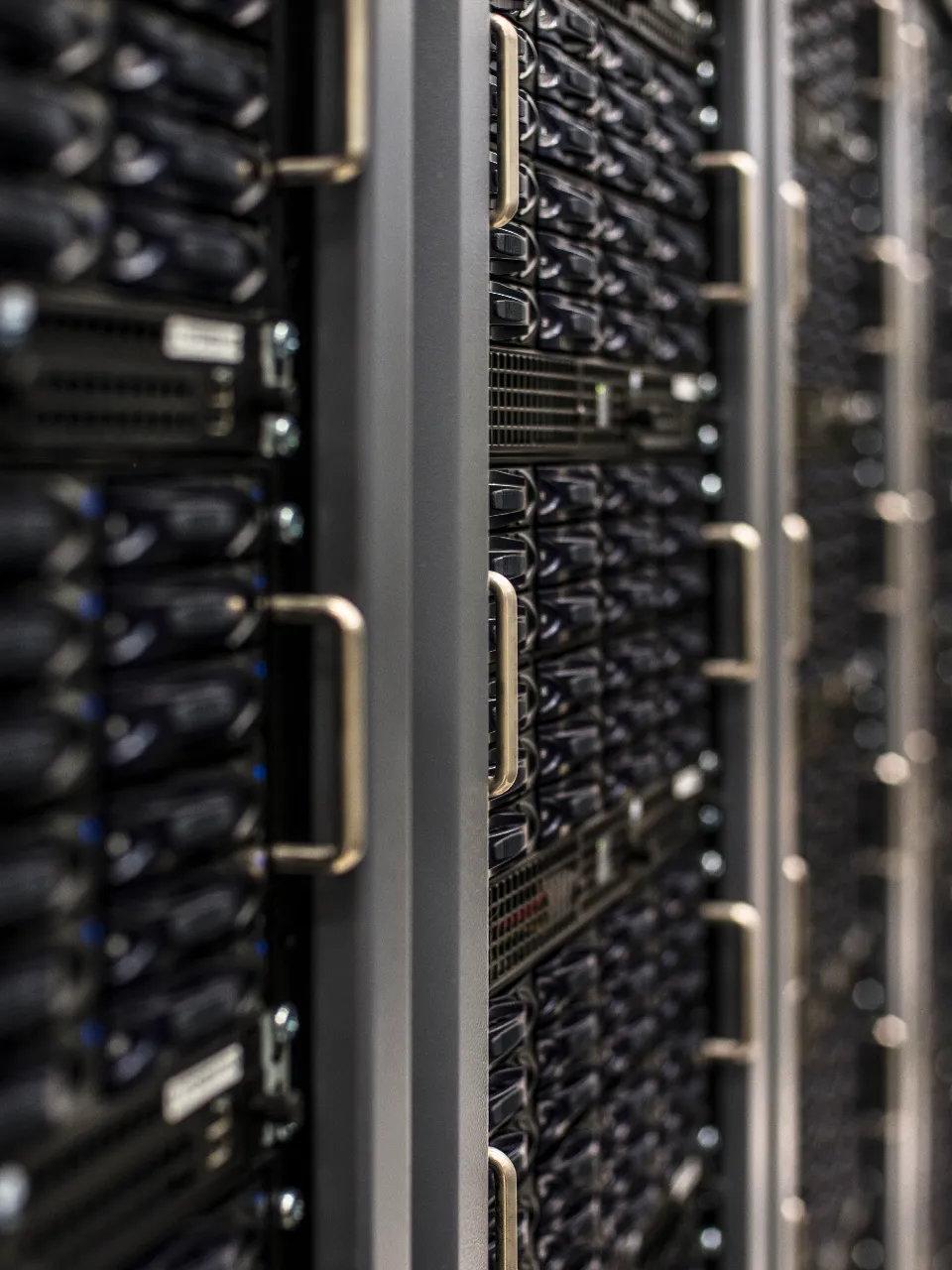 Server rack in the data center.
CERN / Maximillien Brice / Anna Pantelia
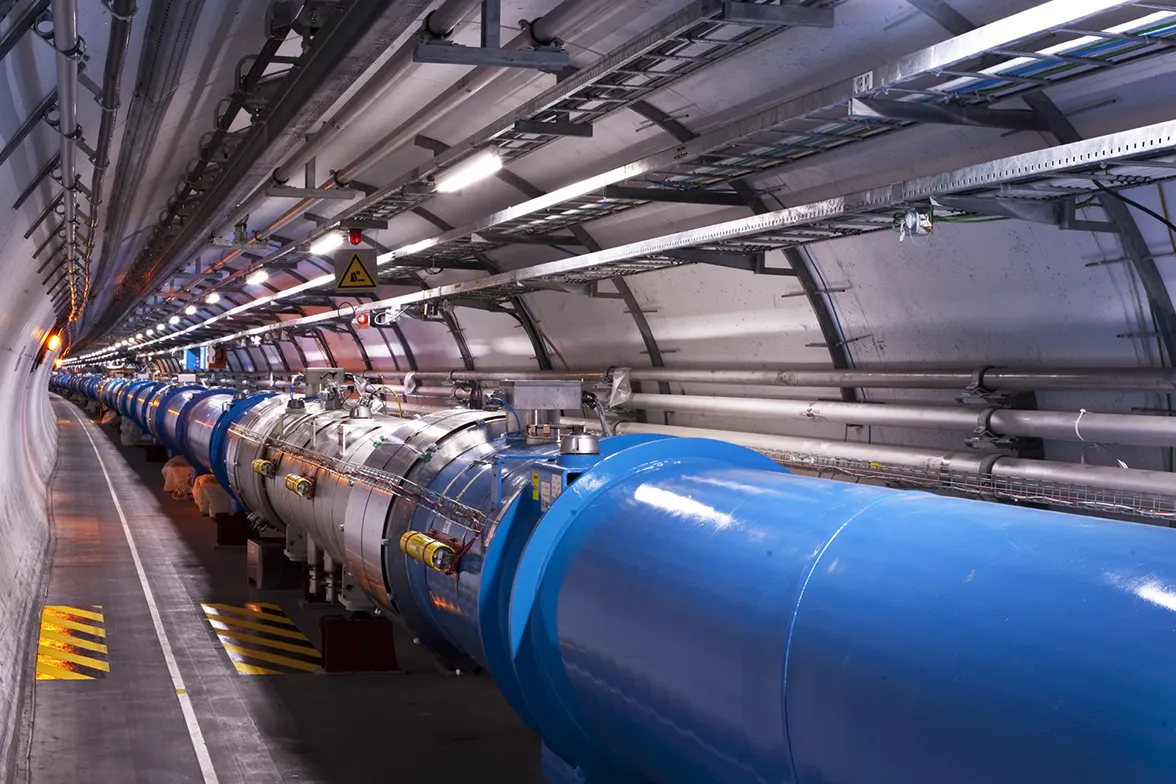 The LHC tunnel in sector 3-4.
CERN / Maximilien Brice
Tell us your
use case
Request a Demo
Related content


